Businesses that want to improve their customer experience often find themselves stuck in complex strategies and over-engineered solutions.
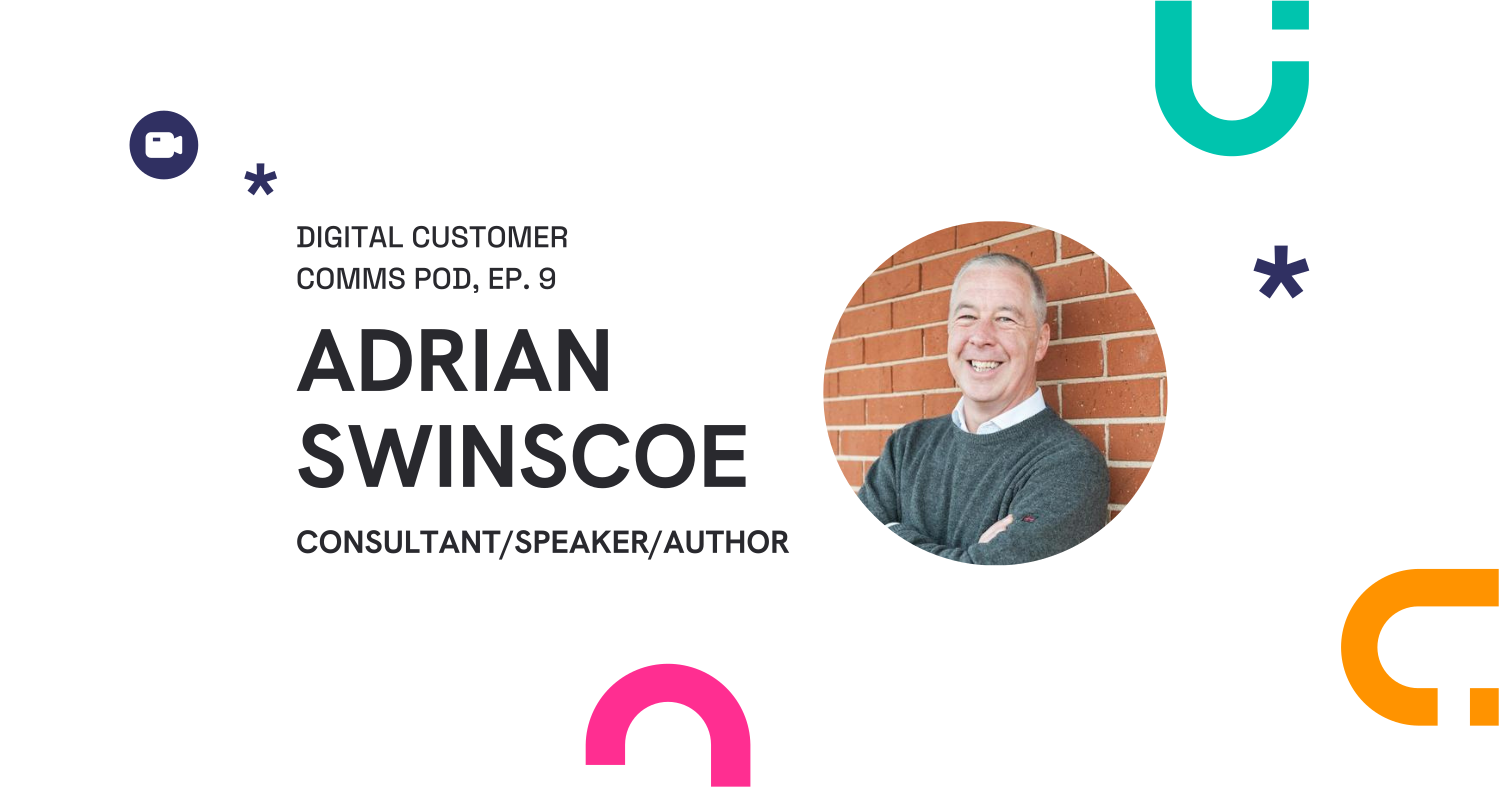
Adrian Swinscoe is a customer experience adviser and author of Punk CX and Punk XL. He advocates a return to simplicity, authenticity, and a human-centric approach.
For regulated firms and other relationship-heavy businesses, that mindset raises a practical question: how do you improve service without adding friction, cost, and process that customers never asked for?
At its core, the punk approach to customer experience is about stripping away unnecessary complexities and focusing on delivering value in the simplest and most effective way possible.
Doing the Basics Brilliantly
Customers today are bombarded with options and information. What they crave is reliability and simplicity.
According to the Global Brand Simplicity Index, 64% of consumers are more likely to recommend a brand because it provides simpler experiences and communications.
The report indicates that brands that simplify customer experience are 86% more likely to be purchased from.
"Most people just want things to work and to do the things they want them to do when they want them to do it.
Companies that do the basics brilliantly, all day, every day, are the ones we generally return to."
Adrian Swinscoe
By excelling at the fundamentals, businesses build trust and loyalty, creating a solid foundation for long-term success.
What The Research Shows
64% of consumers are more likely to recommend simpler brand experiences, according to the Global Brand Simplicity Index.
Simplicity is not the same as doing less for customers. It usually means making the essentials easier to understand and act on.
Humanising Customer Interactions
Despite advances in technology, the human touch remains irreplaceable.
According to Salesforce research, 76% of consumers expect companies to understand their needs and expectations.
Businesses that leverage customer behavioural insights may be able to outperform their peers by 85% in sales growth.
"Customers are talking to you all the time - in emails, phone calls, chats, and messaging.
They're telling you lots of different things that you can use to improve.
All the answers are there; we just need to go look for them."
Adrian Swinscoe
Engaging directly with customers, listening to their feedback, and understanding their unique contexts allow businesses to tailor experiences that resonate on a personal level.
That listening work matters most when firms can turn everyday communication into clearer service decisions, not more process for its own sake.
"Regulated firms often already have useful customer signals in everyday messages and calls. The harder part is designing communication so those signals are easy to capture, act on, and protect when the content is sensitive."
Paul Holland, Founder and CEO, Beyond Encryption (Mailock)
Technology can speed up service, but the firms customers remember are usually the ones that keep the interaction understandable when something sensitive or urgent is at stake.
Human connection can be your strongest competitive edge, even when technology handles more of the routine work.
That balance becomes harder when teams reach for new tools before they have defined what good service should feel like for the customer.
Challenging the Status Quo with Innovation
Adopting a punk mindset means being willing to "zig when others zag."
It's about questioning established norms and seeking creative solutions that prioritise customer needs over rigid adherence to traditional practices.
"Don't just go down the technology rabbit hole.
Step back, envision what would be great for your customers, and then choose the most appropriate tools rather than just choosing tools because it's part of another hype cycle."
Adrian Swinscoe
This approach encourages businesses to focus on the desired customer experience first and then determine the technology and processes needed to achieve it.
Navigating Regulatory Challenges
In industries like financial services, regulatory compliance can complicate customer experience initiatives.
The introduction of measures like the Consumer Duty in the UK has prompted firms to rethink their strategies to ensure fair treatment and positive outcomes for clients.
However, these regulatory demands can widen the gap between businesses and the people they serve.
Research from The Lang Cat indicates that over 55% of advisers no longer serve clients with lower asset levels due to Consumer Duty complexities.
Businesses need to find innovative ways to meet regulatory requirements without compromising the customer experience.
Choosing The Right Customer Channel?
Read our research on portals, logins, email, and post before deciding how customers should receive important documents.
Compliance pressure is real, but customers still judge firms on whether the service feels clear, fair, and human when they need help.
Regulations should not bury empathy. Remember the human at the other end of your service.
Technology choices then need to support that standard rather than replace it with automation that customers cannot understand or challenge.
Leveraging Technology Without Losing the Human Touch
While technology plays a significant role in modern customer experiences, it's crucial not to let it overshadow the human element.
By 2025, AI could power 95% of all customer interactions, but this doesn't mean human interactions become obsolete.
"These new systems are different because the onus for testing and maintenance shifts to the enterprise.
It requires you to assemble people who are going to not just operate the systems but also to test, develop, monitor, and improve them."
Adrian Swinscoe
Balancing technological efficiency with human empathy ensures that customer interactions remain meaningful and effective.
Breaking Down Silos and Fostering Collaboration
Creating exceptional customer experiences requires collaboration across the entire organisation.
No single department can own it entirely; it must be a shared responsibility that flows from the top.
"It has to sit with the CEO.
Ultimately, a business is nothing without its customers, and therefore the responsibility and accountability have to come from the very top of an organisation."
Adrian Swinscoe
Leadership commitment is essential in fostering a culture that values customer-centricity and encourages teams to work together towards common goals.
Case Study: Big Ass Fans
An example of the punk philosophy in action is Big Ass Fans, a company that significantly grew its revenue by focusing on customer feedback.
Founder Kerry Smith employed Dave Sowers to engage directly with customers, gathering insights that led to continuous improvements.
"I pay your salary, but you don't work for me; you work for our customers.
Your job is to find out what they like and don't like and bring it back to the business."
Kerry Smith, Founder of Big Ass Fans
This approach led to a six-fold increase in revenue over five years, demonstrating the power of prioritising customer needs.
The Power of Punk
The power of punk in customer experience lies in its emphasis on simplicity, authenticity, and a relentless focus on what truly matters to customers.
By cutting through complexity and resisting the allure of unnecessary innovation, businesses can foster genuine connections and deliver experiences that resonate.
"Be willing to zig when others are zagging.
Envision what would be great for your customers. Talk to them - they'll tell you everything that you need."
Adrian Swinscoe
Embracing the punk ethos empowers organisations to challenge conventions, prioritise the human touch, and ultimately create customer experiences that matter.
FAQs
What Does Punk Mean in Customer Experience?
It means challenging tired assumptions, doing basics well, and designing around real customer needs.
How Can Firms Innovate without Losing Trust?
Change should improve clarity, access, and service rather than add novelty for its own sake.
Why Do Silos Weaken Customer Experience?
Customers experience the organisation as one journey, even when teams, systems, and responsibilities are split internally.
Sam Kendall works on digital marketing at Beyond Encryption, helping build B2B marketing activity around research, first principles, and sustainable growth. He writes about marketing effectiveness, positioning, customer communications, and digital culture, with longer-form work published at ATNL.
 Sam Kendall


.svg)
 Previous post