The complexities of measuring return on investment (ROI) in communications programmes can make digital transformation challenging, especially for companies in regulated sectors.
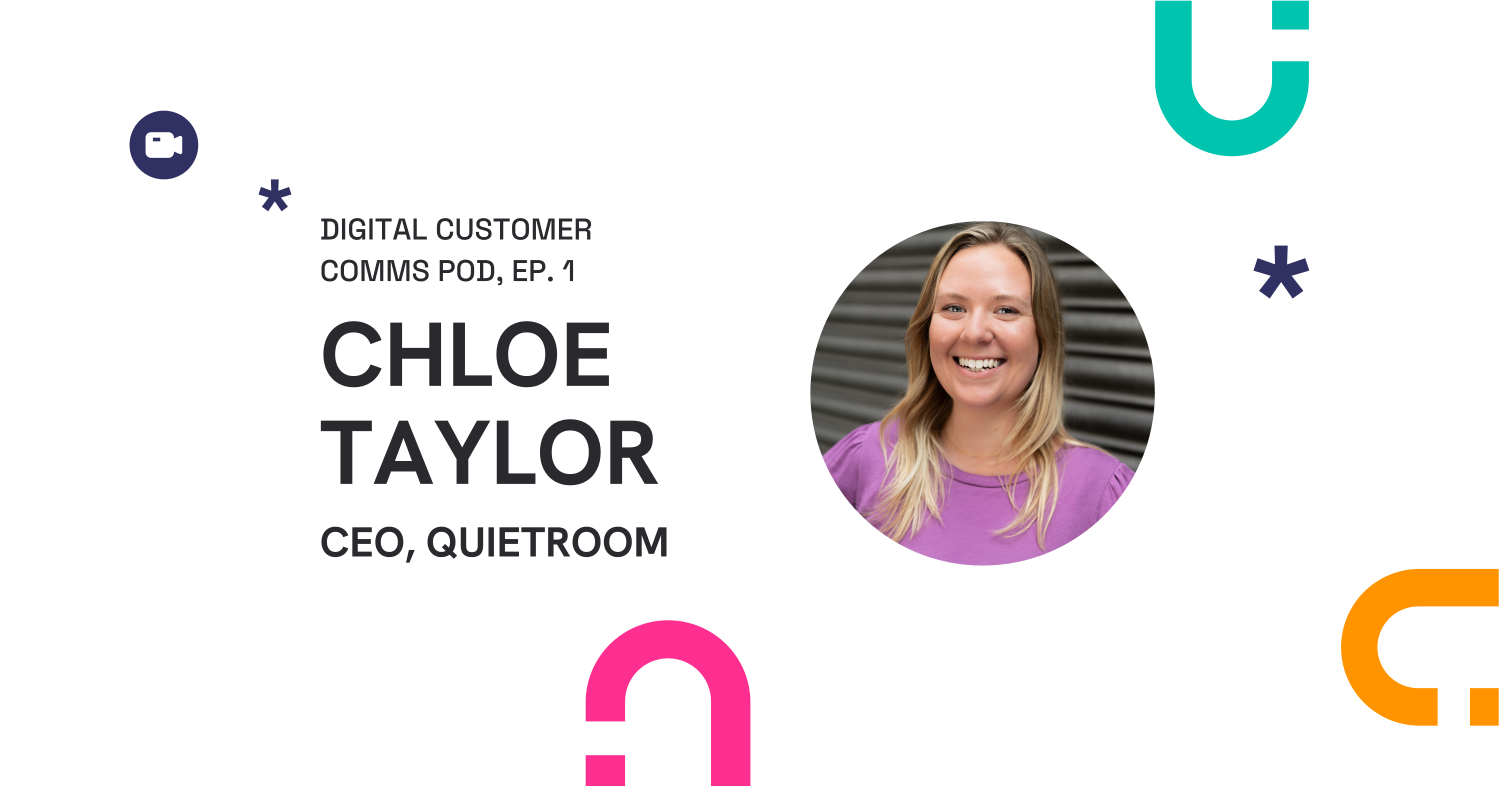
Episode 1 of the Regulated Digital podcast features Chloe Taylor, CEO of Quietroom, on achieving ROI in customer communications.
Quietroom is an insight-led communications consultancy. Taylor helps firms connect engagement work to measurable business outcomes in regulated markets.
Understanding the Complexity of Digital Communication ROI
In many large organisations, communication is often viewed as a standalone function - an isolated piece of the customer engagement puzzle.
However, effective communication is intrinsically linked to broader business goals and must be considered within this larger context.
The goal behind the communication determines how you measure its success.
Measuring the ROI of digital customer communications means understanding both the message being delivered and the behaviour it aims to influence.
For many enterprises, especially in regulated sectors like financial services, the push to digital is often driven by regulatory mandates.
Compliance with these regulations adds a layer of complexity to the communication strategy, making it difficult to assess the true value of these efforts.
“It’s not just about sending a message; it’s about understanding what that message is supposed to achieve.
Whether it’s driving customer engagement or meeting compliance needs, the goal behind the communication determines how you measure its success.”
By digging deeper into the intent behind these communications - whether it’s to comply with regulations, enhance customer experience, or drive specific business outcomes - organisations can better align their communication strategies with measurable goals.
A report by The Real Economy reveals that 69% of financial services companies believe their digital investments will become more important over the next three years, aiming to improve both customer experience and operational efficiency.
The rising importance of digital channels is further underscored by research from GMS suggesting that 69% of consumers would buy more if a company contacted them via their preferred channel.
The Role of Discovery in Crafting Effective Communication Strategies
Before embarking on any digital communication initiative, it’s essential to engage in a comprehensive discovery phase.
This phase involves asking critical questions about the purpose of the communication and the desired outcomes.
For instance, what does the organisation hope to achieve? Is the goal to increase customer engagement, enhance brand loyalty, or simply meet regulatory requirements?
By defining these objectives early, businesses can develop more targeted and effective communication strategies.
An often-overlooked aspect of digital communication is not the communication itself but the entire customer journey.
Map The Communication Flow First
Identify where messages enter the customer journey.
Spot moments where a targeted message can change behaviour.
Check timing and channel fit before scaling content.
Communication should not be viewed as merely the final touchpoint but as an integral part of the entire process, from initial contact to post-interaction follow-up.
By mapping out the entire communication flow, organisations can identify key moments where targeted messages can have the greatest impact.
Sometimes, small adjustments in the process can lead to significant improvements in the overall effectiveness of the communication strategy.
“We often find that small tweaks to the customer journey - whether it’s in the timing of communications or the channel used - can have a disproportionately positive impact on outcomes.”
A HubSpot survey reveals that 44% of leaders believe better measurement of ROI is one of their top priorities for the year ahead, a challenge that is particularly pronounced in the integration of legacy systems and regulatory compliance within financial services.
This complexity underscores the need for a robust discovery phase to clearly define goals and metrics that align with broader business objectives.
Breaking Down Silos: A Unified Approach to Communication
Large enterprises often struggle with siloed operations, where different departments or teams operate independently, leading to fragmented and inconsistent communication.
Overcoming these silos requires a cross-functional approach that ensures all communications are aligned with the organisation’s broader goals and brand values.
One of the most effective ways to unify communication efforts is through rigorous testing.
Research sets the baseline. Testing shows what works for your customers.
By regularly testing communications, organisations can gather valuable insights that help refine their messaging and improve outcomes.
For example, while conventional wisdom might suggest that shorter communications are always more effective, testing has shown that in some contexts - such as explaining complex financial changes - customers actually prefer more detailed information.
These insights can help businesses create more nuanced communication strategies that resonate better with their audiences.
“When organisations take the time to test and refine their communications, they can ensure that their messages not only comply with regulations but also truly engage and resonate with their audiences.”
The benefits of testing are also supported by research from HubSpot, which found that A/B testing in digital communications can lead to a 20% increase in conversion rates.
This iterative approach allows organisations to fine-tune their strategies, ensuring that messages are not only compliant but also effective in reaching and engaging the target audience.
"In regulated sectors, the difficult part is rarely delivery alone. It is showing which communications changed behaviour, met a control need, or reduced avoidable rework downstream."
Paul Holland, Founder and CEO, Beyond Encryption (Mailock)
That discipline matters most when teams need to justify spend, align channels, and show regulators or leadership what changed after a programme goes live.
Leveraging Data and Technology for Enhanced Communication
In the digital age, data and technology are critical components of effective communication strategies.
However, capturing and utilising data effectively remains a significant challenge for many organisations.
Sending Important Documents At Scale?
Learn how Mailock Automated helps organisations protect high-volume customer communications without forcing every recipient through a portal.
The importance of personalisation is highlighted by a McKinsey study, which reveals that effective personalisation can lead to a 5-15% increase in revenue and a 10-30% increase in marketing-spend efficiency.
Furthermore, Epsilon reports that 80% of consumers are more likely to make a purchase from brands that offer personalised experiences.
These statistics underscore the significant impact that well-executed personalisation can have on customer engagement and the bottom line.
Embracing AI in Customer Communications
Artificial intelligence (AI) is increasingly being used to enhance customer communications, offering new ways to personalise interactions and improve efficiency.
AI can help organisations process large datasets, enabling more effective segmentation and personalisation.
AI can enable more precise personalisation and faster analysis of customer data.
This allows businesses to deliver highly targeted communications without the prohibitive costs associated with manual processes.
AI also offers significant benefits in customer service.
For instance, AI can assist customer service representatives by providing real-time information and insights during customer interactions.
“AI’s ability to process and analyse vast amounts of data in real-time is a game-changer for personalising customer communications. It allows us to meet customer needs more precisely and efficiently than ever before.”
This not only improves the efficiency of service delivery but also enhances the overall customer experience.
According to PwC, AI-driven customer interactions can improve customer satisfaction by up to 20%.
Moreover, Gartner predicts that by 2025, 80% of customer interactions will be handled without human agents.
These advancements highlight the growing role of AI in customer communications and the potential benefits for both customers and businesses.
However, the use of AI in customer communications is not without risks.
As customers increasingly use AI tools to interpret and summarise communications, businesses must be mindful of how their messages might be altered or misinterpreted by these tools.
This adds a new layer of complexity to communication strategies, requiring businesses to think carefully about how their messages will be received and understood in a world where AI plays an increasingly prominent role.
Strategic Communication: A Path to Measurable ROI
Achieving ROI in digital customer communications is a complex but attainable goal.
By taking a strategic approach - starting with a thorough discovery phase, engaging in rigorous testing, leveraging data and technology, and embracing the potential of AI - businesses can develop communication strategies that improve customer engagement and deliver measurable business results.
Where customers expect personalised and relevant communications, organisations that invest in refining their communication strategies will be better placed to show what changed and why.
By understanding the broader context in which communications occur and focusing on the entire customer journey, businesses can build stronger relationships with their customers and achieve meaningful ROI in their digital communication efforts.
FAQs
Who Is Chloe Taylor?
Chloe Taylor is CEO of Quietroom, an insight-led communications consultancy. She specialises in helping organisations connect customer communications work to measurable engagement and business outcomes.
What Is the Regulated Digital Podcast?
Regulated Digital is a Beyond Encryption podcast on customer communications in regulated and complex organisations. Episode 1 covers ROI, discovery, testing, data, and AI in digital customer communications.
How Should Firms Measure ROI on Regulated Digital?
Start by defining what each communication is meant to achieve, then align metrics to that goal. Map the customer journey, test message and channel choices, and use data to segment audiences without over-fragmenting content.
Sam Kendall works on digital marketing at Beyond Encryption, helping build B2B marketing activity around research, first principles, and sustainable growth. He writes about marketing effectiveness, positioning, customer communications, and digital culture, with longer-form work published at ATNL.net.
 Sam Kendall


.svg)
 Previous post