Evolving regulation and rising customer expectations are pushing financial services firms to rethink how they communicate, invest in technology, and prove good outcomes.
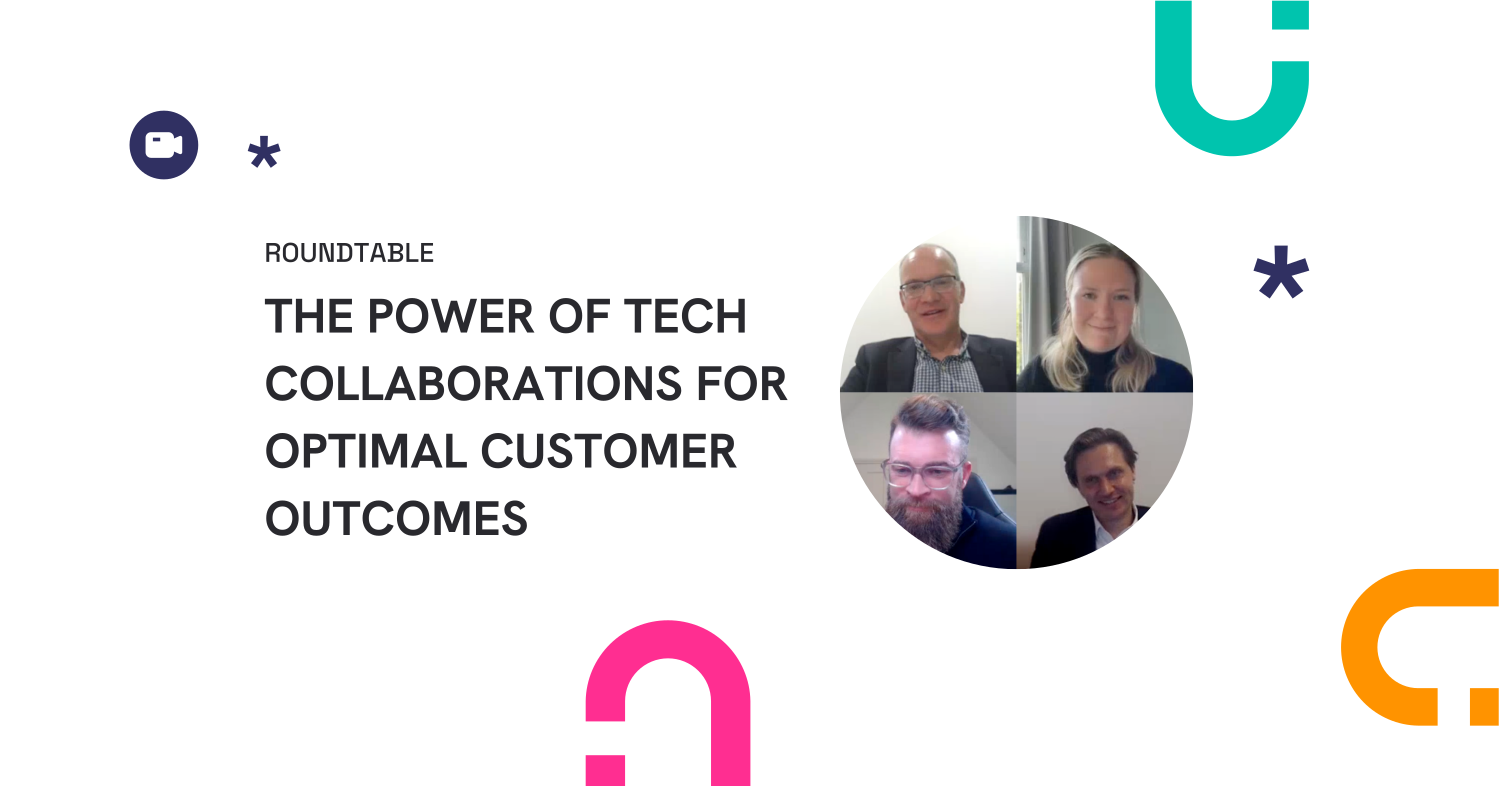
Experts from communications, data, consulting, and technology joined a roundtable on how collaboration and tech investment can improve customer outcomes without sacrificing compliance or service quality.
Together with a panel of industry experts, we explored how technology and collaboration help firms meet new regulatory demands and build foundations for sustainable growth and innovation.
Consumer Duty, cost pressure, technical debt, and weak customer data all shape how firms communicate at scale. The sections below set out where those pressures collide and what the panel said about responding in practice.
The financial industry is under increased pressure to provide good customer outcomes.
Organisations are determined to make greater strides towards improved efficiency - encompassing technology use, cost, and operations.
Compliance and Customer Comms
The compliance landscape is constantly evolving, with regulatory bodies requiring businesses to adhere to certain laws and guidance regarding client communications and data.
The recent emergence of Consumer Duty has added another layer to this complex field. Although many elements within Consumer Duty were already best practice, they are now more formalised, leading organisations to take a deeper look at them.
Chloe Taylor, CEO of communications consultancy Quietroom, argues that Consumer Duty has significantly changed how people approach communication - particularly in terms of frequency and personalisation.
“There are lots of parts of Consumer Duty that talk about the timeliness of communication. There’s very explicit guidance saying that, particularly in the financial advice space, once every two years is not frequent enough to be speaking to your customers and to be giving them advice.”
Chloe Taylor, Quietroom
“One of the big benefits of moving to more digital channels is the flexibility for personalisation, but also for evolving understanding and an iterative approach to what your consumers really want from you.”
Chloe Taylor, Quietroom
Consumer Duty has made a huge push for taking the onus off consumers, ensuring they aren’t provided with vast amounts of information and left to make sense of it all on their own. Quietroom has published guidance on communicating with vulnerable consumers and on beating the curse of knowledge under the regulation.
Communications should be driven by what is known about consumers so that messages land at the right time and in the right context.
“The spirit of the regulation is about the duty that is on the providers, the duty that is on the industry, to do some of the work for people. We’re the experts - and it’s therefore our role to give people the information they need at the right time that is pertinent to them in their circumstances. Sending the same letter to everyone once a year isn’t very helpful. That person’s life isn’t the same as your other consumer’s life.”
Chloe Taylor, Quietroom
Alan Clay, Head of Strategy for Customer Data Solutions at LexisNexis® Risk Solutions, stresses that customer communications need an organisational view to create a singular customer view.
Currently, there is a siloed approach, with correspondence coming from several areas such as operations and marketing, leaving customers bombarded with information and contravening Consumer Duty.
"It’s about sending the right communication through the right channel, at the right time, and to the right person.”
Alan Clay, LexisNexis Risk Solutions
Cost Management
Organisations are increasingly looking for ways to minimise costs without sacrificing service, with Beyond Encryption CEO, Paul Holland, stating that "cost cuts shouldn’t come at the sufferance of consumer outcomes."
Balancing technology investment with tangible customer experience gains is now a board-level question, not only an IT one.
“Enzo Ferrari once said that ‘when a thing works better, it’s usually more beautiful to the eye'. While we’re not building supercars here, I do think the principles are the same, and this is what we see working with a lot of our clients. When a more efficient, streamlined process is built, that benefits both the customer as well as the bottom line.”
Matthew Krzywicki, Alpha Financial Markets Consulting
"It’s not all about cutting costs - it’s about making sure that money is spent in the right way and aligns to strategic imperatives. Making that relatively small investment upfront to understand the customer and bring that thread through any sort of technology implementation is going to help your top and bottom line.”
Matthew Krzywicki, Alpha Financial Markets Consulting
From a cost optimisation standpoint, that usually means a better customer experience and increased retention.
Operationally, processes become more streamlined, with less pressure on call centres and customer service teams. Alpha Financial Markets Consulting argues that embracing digital transformation in customer communications is now a strategic imperative for regulated firms.
Tackling Technical Debt
With companies now increasingly prioritising customer experience by onboarding new tech, a problem has arisen in the market - that of technical debt.
When financial organisations invest in new solutions without removing the old, they create a significant build-up of legacy software and waste.
Choosing The Right Customer Channel?
Read our research on portals, logins, email, and post before deciding how customers should receive important documents.
Simon Leuty, Founder and Chief Innovation Officer of Livingstone Group, describes the pattern firms fall into:
“We’re seeing people try and react to their customer demands, we’re seeing them react to regulation, but what we’re not seeing them do is clean up afterwards.”
Simon Leuty, Livingstone Group
“Some of these systems are archaic and incredibly complex to change, which keeps you on that old stack. The older that stack becomes, the more it costs you to support, and that’s why you have to tack on all the new bits on top of it. You’re just in this perpetual cycle of inefficiency.”
Simon Leuty, Livingstone Group
Technical debt limits growth and slows adaptation when legacy stacks absorb budget without matching revenue gains.
“What we’re seeing in the market is double-digit budget growth, but not double-digit benefit. Software budgets go 20% year-over-year, but revenues are not. What that’s telling us is people are not getting the value from that technology.”
Simon Leuty, Livingstone Group
“With a complex tech landscape, you’re unable to adapt to changes in the industry, whether that be regulatory changes or competitive pressures. That can really hamstring growth.”
Matthew Krzywicki, Alpha Financial Markets Consulting
Beyond Encryption CCO, Adam Byford, notes that technical debt cannot be avoided entirely, especially where admin systems in the financial sector have been in place for decades.
"You mustn’t let it restrict your ability to innovate, because if you don’t innovate, you’re going backwards."
Adam Byford, Beyond Encryption (Mailock)
One key method to minimise technical debt lies in tech hygiene, identifying and removing hardware or software within your stack that is no longer useful. Livingstone outlines how firms can tackle market challenges from a software asset management perspective when optimising the operating model.
“Freeing revenue up in those spaces by just doing what you should be doing anyway, which is managing your estate, is where you can wheedle out revenue for innovation and other process efficiencies.”
Paul Holland, Beyond Encryption (Mailock)
Data and A Customer-Centric Approach
With customer expectations continuing to grow, there is significant pressure on businesses to provide services that meet their demands.
"The financial industry is well behind other industries in terms of what it provides its customers with and how it understands them."
Adam Byford, Beyond Encryption (Mailock)
The human instinct to improve customer service often starts with adding more - more tech, more communication channels, or more paragraphs in a document.
"None of these are necessarily bad options. But they often come from a place of a lack of clarity about what you’re trying to achieve. You need to ask yourself; what have you done and is it working? And if it’s not, how much awareness do you have about why it’s not working?”
Chloe Taylor, Quietroom
That points to a vital need for insights - in other words, building a robust framework with accurate data.
"We know from all the research that asks people what they want, the results are ‘tell me about my money. I want to know what’s happening to it, where it is, and what I can do with it.’ The only way that the industry can satisfy that need and desire from consumers is through good quality data.”
Chloe Taylor, Quietroom
Financial organisations need a holistic approach that checks information for correctness and timeliness. An incorrect date of birth or an out-of-date address can undermine engagement across channels.
“With the evolution from sending out a letter once a year, to now more frequent and interactive digital communication, there’s a two-way continuum - meaning your data now needs to be as good as it possibly can be. It’s not a one and done - it’s a continuous monitoring to make sure that whenever your data is used, either proactively or reactively connecting the right dots together to give customers the right experience.”
Alan Clay, LexisNexis Risk Solutions
“When you think about managing software and investments effectively, we need three key data sets. ‘What do you own, what are you using, and then what do you need in the future? If that’s not a clean data set, it’s incredibly difficult to make an informed decision.”
Simon Leuty, Livingstone Group
Many organisations still hold back on personalisation because they fear using the wrong data.
“Because schemes and businesses are so afraid of the wrong data, they shy away from a lot of opportunities that are there for personalisation. That fear drives a lack of innovation and a lack of people being willing to, at least for a portion of their consumers, give them what they really want and need, which is tailored information about them and their circumstances.”
Chloe Taylor, Quietroom
Top Advice From The Experts
Many organisations know they want and need to do better. The panel closed with practical advice on where to start.
Gain Deeper Insights
“Frequently, we find that businesses and organisations don’t really know what their consumers do and don’t understand, what they do or don’t want from their providers. Insight is a really big thing upfront so that you then invest in the right changes.”
Chloe Taylor, Quietroom
Build A Foundation
“It’s fundamentally about getting more of the basics right, more of the time, and that’s where the first wins are. Then, when you’ve got a solid foundation, you can build for the future from there. Don’t build the future on a bed of sand.”
Alan Clay, LexisNexis Risk Solutions
Identify Your Metrics
“As they say - ‘what is measured is managed’. Being able to understand that the correspondence was opened, that it was opened by the right person, and then be able to track that there was an action made on the back end of that is incredibly valuable for managing a business and demonstrating the impact of communications.”
Matthew Krzywicki, Alpha Financial Markets Consulting
Seek Advice From Specialists
“Expect the challenges that you come across to be very varied, and don’t try to answer them all yourself. Seek help - there are people who are experts in very specific areas, and if you get help from one of them rather than trying to answer everything yourself, then that’s going to be of benefit to you and to your customers.”
Adam Byford, Beyond Encryption (Mailock)
And Finally, Some Last Words Of Wisdom
Change Doesn’t Always Yield The Desired Results
“If it doesn’t work - that’s fine. You can learn from your failures of things that you tried, as long as you find out why it didn’t work instead of moving on without the learning experience.”
Alan Clay, LexisNexis Risk Solutions
Some Change Is Better Than None
“You’re not necessarily going to get it perfectly right, but just getting it a bit right is actually going to generate a significant gain. Sometimes people are overwhelmed by the task and intimidated by even getting started, but you have to start somewhere to drive those efficiencies.”
Simon Leuty, Livingstone Group
Don’t Underestimate The Power Of Collaboration
“To use a Formula One analogy - the driver and the car are two different components, with the car being built by a whole team of experts. It’s that collaborative piece, with all working together towards that common goal being where the best results come from.”
Alan Clay, LexisNexis Risk Solutions
FAQs
How Has Consumer Duty Changed Customer Communications?
Consumer Duty has formalised expectations around timeliness, personalisation, and provider responsibility. Firms are expected to communicate more frequently and more relevantly, rather than sending the same annual letter to every customer.
What Is Technical Debt Doing to Financial Services It Budgets?
Panel members described software budgets rising around 20% year-on-year without matching revenue or operational benefit, often because new tools are layered onto legacy stacks that are never retired.
How Should Firms Balance Cost Cuts with Customer Outcomes?
Cost reduction should not come at the expense of consumer outcomes. Investment in understanding the customer and aligning technology spend to strategic priorities can improve both service quality and financial performance.
Paul, CEO and Founder of Beyond Encryption, is an expert in digital identity, fintech, cybersecurity, and business. He developed Webline, a leading UK comparison engine, and now drives Mailock, Nigel, and AssureScore to help regulated businesses secure customer data.
 Paul Holland


.svg)
 Previous post