Smart data can feel abstract, but for Smart Data Foundry it's about using real financial lives to shape fairer decisions, safely.
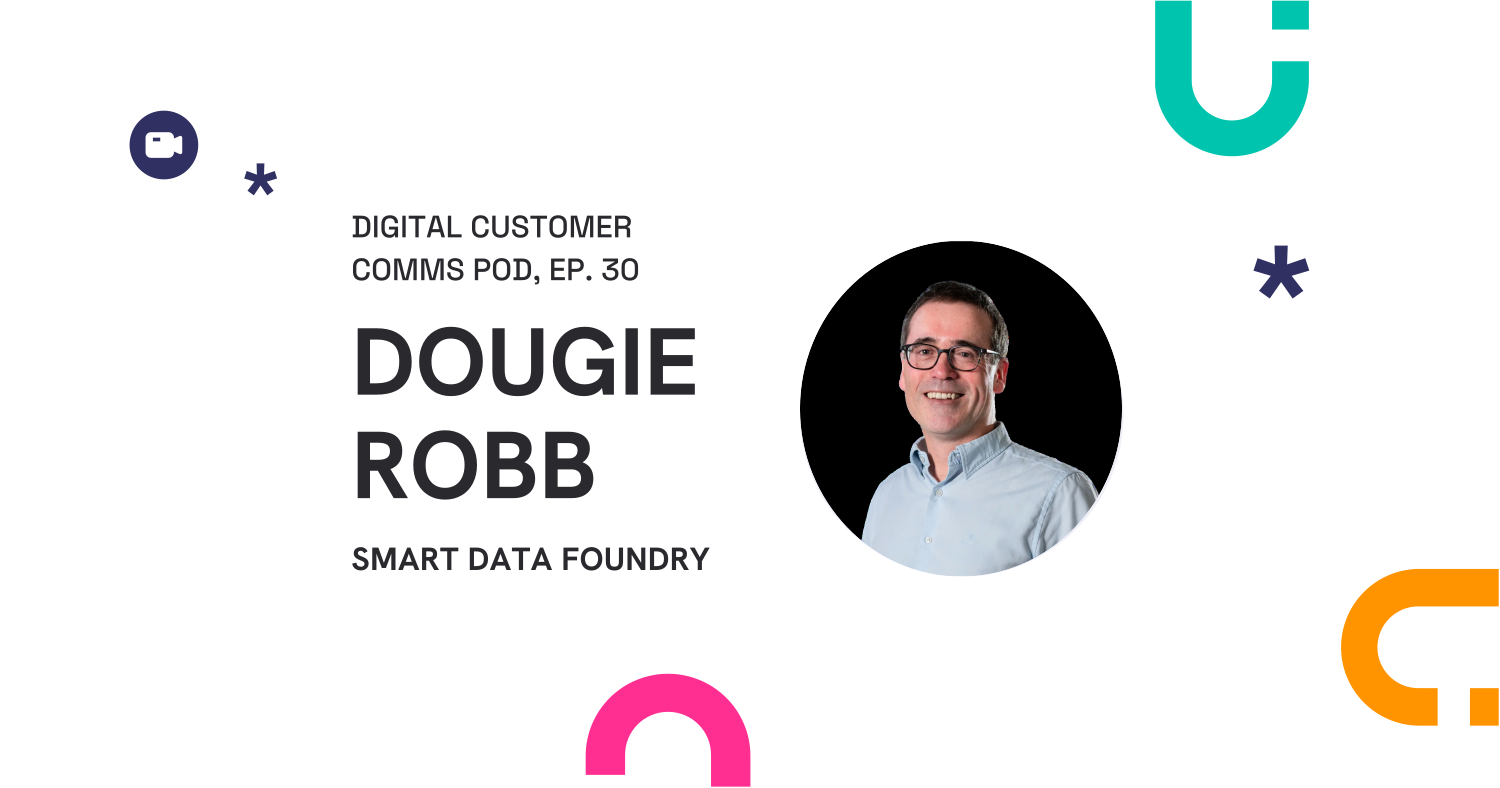
In this episode of Regulated Digital, we speak with Dougie Robb, CEO of Smart Data Foundry, a subsidiary of the University of Edinburgh that helps unlock financial data for social good.
Smart Data Foundry curates anonymised financial data inside a secure “safe haven” environment designed for sensitive public-sector datasets.
Their work sits at the intersection of banks, regulators, data scientists, and local authorities.
They turn real-world data into insight that can improve financial resilience, public health, and net zero planning - always with clear ethical and governance boundaries.
A trusted smart data future depends on representative data, clear governance, and AI used to support research without increasing risk.
Created from episode transcript
From Open Banking to a Smart Data Economy
The smart data conversation starts with a simple question: What happens when people can safely share more of their data, across more services, to get better outcomes?
A trusted smart data future starts with consent people can understand.
Open banking has already shown what that can look like.
Recent figures suggest around one in five UK consumers and small businesses now actively use open banking services, with tens of millions of open banking transactions happening each month.
Those services are no longer niche fintech experiments.
They are embedded in everyday products that help people compare accounts, smooth cash flow, or verify identity securely.
The UK Government’s roadmap aims to extend this into a broader smart data economy across sectors such as banking, energy, telecoms, retail, and home-buying.
The goal is simple: use secure, consent-based data sharing to help people get fairer deals, better support, and simpler experiences across essential services.
What Smart Data Foundry Actually Does
For many organisations, smart data still sounds abstract.
The work becomes clearer once you see how the data is curated and governed.
Smart Data Foundry works with financial institutions that donate anonymised data from products such as current accounts.
The data is processed and held within a secure environment operated by the University of Edinburgh’s computing centre, using a safe haven model designed for sensitive public-sector datasets.
Inside that environment, Smart Data Foundry curates the data, standardises it, and links it with sources such as income indicators and housing information.
The outcome is a set of well-prepared datasets and dashboards that accredited researchers and policymakers can use to answer concrete questions.
For example, where financial distress is emerging in a local area, how people move in and out of the workforce, or how household finances relate to housing quality and child health outcomes.
"Data is not the solution in itself, but it can show where problems are emerging so interventions can land earlier and do more good."
One of the biggest risks in smart data projects is representativeness.
More data does not automatically mean better insight.
Without care, datasets can amplify blind spots or exclude people whose experiences matter.
Even mainstream banking data has quirks:
Coverage may be stronger in Scotland than in parts of England due to legacy brands.
Consent-based models can skew towards people who are already digitally confident.
More vulnerable groups may be under-represented.
For Smart Data Foundry, representativeness is treated as a core design constraint.
Build a Balanced Data Portfolio
The goal is building a “balanced data portfolio”.
That means combining current accounts with products such as mortgages and pensions that shape long-term resilience.
It also means looking for ways to understand the experiences of people who are lightly served or unbanked.
Where gaps can't be filled, they are openly acknowledged to users of the data.
Blend Data with Lived Experience
Data is never treated as the only source of truth.
Smart Data Foundry combines quantitative insight with local knowledge and lived experience from councils, community groups, and subject matter experts.
This matters because real-world decisions - about housing, debt, health, or resilience - rely on more than numbers.
Trust, Governance, and a Safe Haven
Smart data presents challenges to trust.
Most people are cautious about how their financial data is used, especially in light of past misuse by data brokers.
Trust has to be earned on multiple levels.
Use Infrastructure People Already Trust
The data is held within a university-operated safe haven environment designed for sensitive public-sector datasets in Scotland.
This infrastructure is physically and logically isolated, with strict access controls and monitoring.
Layer Technical, Legal, and Ethical Controls
Smart Data Foundry uses multiple layers of control to reduce re-identification risk:
Data is anonymised before analysis.
Cohorts below certain thresholds are excluded.
Every project undergoes an internal and institutional ethical review.
Legal agreements define permitted uses and explicitly prohibit targeted marketing or profiling.
"We're very privileged to have access to this data, so we have to be clear about what we will and will not do with it."
In a world of consent dashboards and data toggles, clarity is essential.
Smart Data in Action: Case Studies with Real Impact
Several practical examples show how careful, well-governed data use can lead to better decisions on the ground.
Spotting Financial Distress in a Single Neighbourhood
In one local authority project, anonymised banking data revealed a neighbourhood showing signs of emerging financial strain.
Traditional indicators had not captured the pattern.
The insight helped the council design a targeted support offer for households under pressure.
This mirrors the kind of work organisations like Policy in Practice deliver to councils across the UK.
Linking Money, Housing, and Net Zero Decisions
Another project integrates financial resilience metrics with public data on energy performance certificates.
The aim is to understand how household finances affect the affordability and feasibility of retrofitting homes for net zero.
This kind of cross-dataset insight can help design support that is both greener and fairer.
Understanding Health Impacts through Linked Data
In partnership with researchers, Smart Data Foundry contributes financial datasets for research into how income, housing, climate, and pollution factors relate to respiratory health in young children.
The health components of this work remain with health research partners.
The aim is to create a more complete understanding of environmental and social factors affecting early childhood health.
AI, Predictive Analytics, and “Baby Steps” in High Stakes Settings
AI is becoming part of every data conversation.
Smart Data Foundry is exploring language models within its secure environment to help researchers navigate documentation and metadata.
The goal is not replacement.
It is to augment researchers’ ability to work with complex datasets.
Any AI used in the safe haven must be fully contained and cannot transmit information externally.
Beyond this, predictive analytics could help policymakers see where emerging trends might lead.
Even here, Smart Data Foundry’s approach is measured.
New methods are tested in small, controlled settings before scaling.
What Regulated Organisations Can Learn
Smart Data Foundry’s work offers lessons for financial services, energy providers, insurers, and other regulated sectors.
Start with a Concrete Use Case
Choose one clear use case and prove it at a small scale.
This could involve supporting a vulnerable segment, improving early-warning indicators, or strengthening a local partnership.
A small, successful pilot offers more value than a broad, theoretical strategy.
Invest in Consent, Comms, and UX as Much as Infrastructure
As smart data schemes expand, people could end up managing consent across multiple sectors.
Without thoughtful design, this risks turning empowerment into admin.
Clear, well-designed interfaces may matter more for trust than another policy document.
Align Smart Data Projects with Consumer Duty
Smart data is closely aligned with regulatory expectations around fair value, vulnerability, and consumer outcomes.
With strong governance, richer data can help identify at-risk customers earlier and evidence positive impact.
Without it, the same data can support opaque or unfair models.
The path forward is clear governance, small steps, and clear communication.
"When firms open more data flows, the board question shifts from volume to proof: who can access what, under which consent, and with what evidence if something goes wrong."
Paul Holland, Founder and CEO, Beyond Encryption (Mailock)
FAQs
What Is Meant by “Smart Data” in This Context?
Smart data refers to customer data that can be securely shared with authorised third parties to create better services under clear rules and safeguards.
In the UK, this concept extends beyond open banking into sectors such as energy, telecoms, and home-buying.
How Does Smart Data Foundry Differ from a Typical Data Broker?
Smart Data Foundry is mission driven and works within a university-operated safe haven with strict rules that prevent data being used for targeted marketing or commercial profiling.
Its focus is on enabling research and public-benefit projects.
Why Is Representativeness a Concern in Smart Data Projects?
If data over-represents certain groups or regions, insights and decisions built on that data can unintentionally disadvantage others.
Careful design, documentation, and blending multiple sources helps reduce this risk.
What Role Should AI Play in High Stakes Data Work?
AI should be assistive, not autonomous.
In sensitive environments, models must be contained, auditable, and unable to transmit data externally.
Human oversight remains essential.
How Can Regulated Firms Start Using Smart Data Responsibly?
Identify one consumer outcome to improve, assemble a cross-functional team, and run a small, controlled pilot with clear guardrails.
From there you can build out controls, documentation, and comms before scaling.
Sam Kendall works on digital marketing at Beyond Encryption, helping build B2B marketing activity around research, first principles, and sustainable growth. He writes about marketing effectiveness, positioning, customer communications, and digital culture, with longer-form work published at ATNL.
 Sam Kendall


.svg)
 Previous post